Friday, 16 January 2015

February, first stirrings of spring

I've never been the type of gardener who shuts up shop at the end of November, cuts everything down to the ground and puts the garden to bed for the winter. I admit there are some plants which collapse into a mushy heap at the first frost and are just too messy to live with but I always leave the majority of perennials in my garden to stand as bleached silhouettes right through the winter.

In late autumn they are festooned with dew covered orb spider webs, they look fabulous in the frosts, give a home to over wintering insects and are fastidiously picked over by birds searching for any remaining seeds, but they having taken a battering by the strong winds and are looking a bit the worse for wear now so it's time for me to get out there and start cutting down and clearing up.
All that dead top growth has also been protecting emerging new shoots, so if it stays really cold I'll wait until later in the month and by then there will be a lot more new growth for me to see too.

Unlike clearing up at the beginning of winter, after which parts of the garden are left looking bare and bleak for weeks, we know that despite the cold there is so much new life getting ready for the first signs of spring to burst through the soil and break from branches, so that now it's an altogether much more cheerful and uplifting exercise.

There are hidden gems to find at this time of year too, although it's technically still winter, under all that dishevelled foliage the first flowers of spring are already appearing. Pointed spears of daffodil bulbs, the delicate dangling white bells of snowdrops, the first primroses and rising from last years leaves, hellebore buds are opening out into the most beautiful and exotic flowers. 


It's not just plants feeling the first stirrings of spring, if we're lucky February  sees amorous frogs returning to the pond to spawn.


Those glistening balls of black studded jelly are for me the real beginning of a new year in the garden, just as exciting to see as they were when I was five. I gave up collecting frog spawn in jars many years ago but despite the finger numbing iciness of the water I just can't help it, I still have to get my hands in there!


Sunday, 14 December 2014

From me to me at Christmas

I know this is cheating but just in case I don't get the gift of a book for Christmas, I've bought myself not just one but two.

'The Wild Garden' by William Robinson was first published 144 years ago to illustrate to the Victorian gardener a naturalistic and informal alternative to the fashion for seasonal tender plants used in rigidly formal displays. Although radical at the time you would expect that with the passing of the years his message would have lost its relevance, but with the ever more pressing need for us to garden in a sustainable way, William Robinson's ideas are just as relevant today. Using plant communities that coexist easily and happily without the need for a huge amount of intervention from us to cover the ground and exclude weeds with their vigour is a great way to plant for a Victorian or modern gardener.

The other book I've treated myself to is bang up to date and by two of the leaders of current planting styles, 'Planting A New Perspective' is by Piet Oudolf and Dr Noel Kingsbury. They describe ways of planting to achieve a naturalistic look and an easy maintenance regime using plants suited to the garden's conditions. At first glance these books couldn't look more different from each other, one illustrated by small black and white line drawings the other packed full of exciting vibrant photographs of planting combinations, an explosion of colour, shape and form.
Yet at their heart both books ask gardeners the same thing, to think about what we plant and the way we do it, to understand the plants' needs and use them in combinations which encourage them to perform their best for us in schemes which are easy on the eye and are not difficult to maintain.

It's incredible to think how much has changed in the last 144 years and yet in the world of plants, despite so many new ones having been brought into cultivation. the message remains basically unchanged. It's all about gardening with thought.
By coincidence, it just happens that there's another book I quite fancy called 'The Thoughtful Gardener', but I couldn't buy myself three Christmas presents could I?


Sunday, 26 October 2014

Weeding.....


Weeding the garden is a bit like doing the house work, I know that if I keep putting it off things will only get worse and yet I've been doing just that for the best part of a year. I'm a reluctant weeder, not because I find it a tedious task but because I actually rather like weeds. Having evolved to be perfectly suited to our growing conditions, our wild flowers are much more at home here than the fancy ornamentals we would rather have, but there are some that are so successful even I must concede that they really do have to go.

Given the tangled mass of foliage in my beds and borders, any sensible person would dig over the soil pull out all the weeds and throw the lot on the compost heap. But contrary to sound gardening advice if I don't know what a plant is I'll leave it and see what it turns out to be, so my weeding efforts can be very long winded as I inspect and attempt to identify all the seedlings of granny's bonnet, teasel, self heal, valerian, viola, vetch and anything else that might have decided to pop up. I enjoy gardening on this intimate scale, close up, down and dirty with the woodlice worms and beetles. It also means that I don't inadvertently dig out any of the self sown hellebores, poppies, fennel and verbena and it allows me to get to know my garden and its inhabitants in much finer detail.

Where the buttercups are growing the ground retains moisture, the soil is richer so I know it will be a good place if I want to grow Hosta, Rodgersia or Ligularia. The dry patches at the edges of paths I've found to be alive with ants, perfect spots to watch out for a visit from a hungry green woodpecker and at the base of a dry stone wall is a daytime hiding place for snails where I can sometimes see the thrush hunting.
On hands and knees I'm at eye level with the blackbirds taking their daily bath in the pond and the robin as he follows my progress inspecting the disturbed ground for insects.

This isn't just weeding and it's certainly no chore, what I'm really doing is getting to know my garden intimately and hopefully next year we will both be all the better for it.


Self heal - the name gives it away, it used to be used to heal wounds.


Beautiful buttercup


Teasel - brilliant for goldfinches
Granny's bonnet - self seeds everywhere, a great gap filler

Sunday, 24 August 2014

Gorgeous, graceful grasses

Ornamental grasses seem to divide opinion more than any other group of plants. Some people, myself included, love them for their grace and elegance, the way they catch the breeze and add colour and movement to the late summer and autumn garden.
Others view them as a passing fashion, or worse, as nothing more interesting than stray seedlings from the lawn to be ripped out with the creeping buttercup and bindweed.

They may be relative newcomers to our gardens but I firmly believe that their positive contribution is here to stay. Some designers like to use grasses in bold contemporary blocks of single species, some in prairie style mixtures with other late flowering North American plants, their natural bed fellows. In my own garden I like to experiment with plant combinations and I've found the diversity and versatility of grasses to be indispensable, they are simply brilliant garden plants.

The cascading copper and olive foliage of Anemanthele lessoniana tones beautifully in shade with the fern Dryopteris erythrosora or in sun with orange roses like 'Lady of Shallott' and makes a perfect backdrop to the sky blue geranium 'Rozanne'. As autumn approaches the tiny droplets of bronze flowers on long falling stems are perfect with Aster 'Monch' and Kniphofia 'Little Maid' or 'Bees Lemon'. 
Low growing with a dense arching habit it's perfect for covering difficult banks

For height without heaviness Miscanthus 'Morning Light' is just lovely. Upright and slightly arching at the tips with a fine white stripe through the light green leaves, it rises slowly over the summer to form a statuesque plant, perfect with Anemone 'Honorine Jobert; white Hydrangea quercifolia or Fuchsia 'Hawkshead, very refined and elegant.

As the year moves on and the colour in the garden begins to turn, grasses with good autumn hues shoot like flames around the skirts of fiery leaved shrubs and trees like Acer palmatum, Cotinus coggygria and Amelanchier lamarkii.   Imperata 'Rubra' has red tipped leaves all summer and many of the Panicums have brilliant red autumn foliage, spectacular when teamed with deep red Persicaria amplexicaulis 'Blackfield'.

If you're new to grasses and it's all year round versatility you're after then Stipa tenuissima is hard to beat, light and airy the foliage and long lasting wispy flowers float among so many perfect companions from geraniums and roses to lavender and Potentilla fruticosa cultivars, it's a brilliant grass for any garden style.


Saturday, 19 July 2014

'Bee neighbourly'

Whenever I'm out in the garden I always feel the need to be doing something, pulling up bindweed, watering pots, rescuing a plant in the greenhouse from heat stroke, I do find it difficult to just sit.

But I must do try harder because it's in those quiet, still moments when we're just being not doing, that we actually appreciate just how much other activity there is. When we stop being busy ourselves and take notice of what's going on around us it's remarkable how industrious animals are and none more so it seems to me than the wild bees. They have to be I suppose to cram their life's work into just a few short weeks.

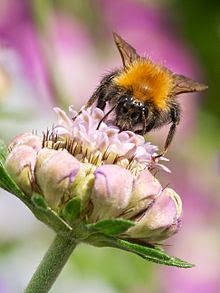
I'm paying more attention this year because I have a brilliant bee identification chart so now I can put names to them. Some which I'd always assumed to be just smaller bumble bees are actually solitary ones which as their names suggest don't live in colonies but lay their eggs in individual holes in walls, or in the ground like the tawny mining bees which I watched in the spring disappearing down cracks in the lawn's bare patches. They are the little ginger furry ones, white bottomed ones with the fluffy boleros I've discovered to be tree bumble bees and the black ones with bright orange bums are red tailed bumble bees. There are several with yellow stripes, but they'll have to slow down a bit before I can be confident enough to know whether I'm seeing a buff tailed or a white tailed or even a garden bumble bee!

I always feel much more of an affinity with something when I know what it's called, like being on first name terms with the neighbours, the more I know about the bees which share my garden with me the less likely I am to do something to upset them and just like any good neighbours we help each other out. I leave my lawn uncut so they have big patches of clover, birds foot trefoil and bush vetch in which to forage and from the densely packed fruit along the branches of the plum trees they were very busy pollinating for me this spring.
A very fair exchange, I do hope we stay on good terms now the runner beans are in flower!


Tuesday, 3 June 2014

Scentsational!


I have made a promise to myself that this year I will not squander the lovely long summer evenings inside, neither at my desk working nor in front of the tv, but be outside enjoying the daylight hours in my garden for as long as I possibly can and so far I'm sticking to it.
I'm equally happy doing something useful and productive like a stint digging in the veg patch or just pottering around looking which new flowers have opened and noticing as day by day the garden gently settles down from it's fresh spring flush into the soft fullness of early summer.

So well known by day, the garden changes into an unfamiliar and magical place as dusk gathers, the blackbirds which always seem to be the last birds to stop calling fall silent and the rooks and jackdaws pass over following the same flight path every night on their way home to roost.
As the natural light fades there's a chance to see bats flit silently but swiftly over the pond on the hunt for moths and as all the colours disappear, in monochrome, any white flowers glow as if artificially lit.

As vision become less certain we notice other sensations like the drop in temperature and a freshening breeze. Hearing becomes a bit more acute picking up the typical night time 'twoo' of a tawny owl and a sharp 'twit' answering call and the scents of the night garden are suddenly really noticeable.
There's the heavy sweet perfume of so many flowers, late bluebells, lilac, honeysuckle, wisteria and as June wears on roses pervade the air but to sniff the delights of many plants we need to rub the leaves to release their oils. Herbs like rosemary, thyme and sage evoke a succulent Sunday roast, Perovskia, Santolina and lavender are a reminder of a Greek island holiday. Mint has to be the freshest of all scents especially after rain, just like toothpaste, but for me the best of all the garden's many wonderful perfumes is yet to come. I'm looking forward to one of the highlights of high summer, walking into a warm greenhouse full of tomato plants, it's just scentsational!


Sunday, 20 April 2014

Feeling right at home


From the number of people I see gazing into estate agents' windows, who like me are probably not in the market for another house move, I guess I'm not alone in being nosy about other people's homes. But I wonder how many are as interested as I am in the gardens surrounding them. It's rare to find the garden mentioned as a particular selling point and even rarer to see 'beautiful south facing garden' as I did recently. I think that the orientation of the garden is very important, but not long ago I saw a new client for the first time who had no idea which way her back garden faced and on showing her with a compass she was horrified to find it was north east, so surrounded by very tall buildings, only in mid summer would the sun shine directly into her garden.
For a sun worshipper or lavender lover this would have been a disaster but as it turned out that she didn't like to sit in the sun and her favourite plant was Alchemilla mollis then thankfully my visit ended well.

In most gardens, as the sun moves around it, we can move our spots to sit and benches strategically placed in a few locations not only give us different views but also the choice to be in light or shade.
Our plants unfortunately have to put up with what they've been given and all too often planting is a case of looking for a gap and sticking it in which at best only gives the poor plant a fifty/ fifty chance of survival. It's good for plant sales of course when we buy a replacement but it's entirely possible to avoid the guesswork and buy appropriate plants for the conditions we have and embrace the philosophy of putting the right plant in the right place.

The first rule of green fingers is to make an honest appraisal of our garden and consider which plant's tastes we might best accommodate, like lavender, thyme and sage from dry and sunny Provence, rhododenrons and camellias from the misty forests of Asia, grasses from the open prairies of America or should it be bluebells, wood anemones and wild garlic from under the opening canopy of a British woodland.


Although impulse buying plants is very tempting, for just a bit of consideration they really will repay our thoughtfulness and just as we do, they settle best, grow well and thrive where they feel most at home.